

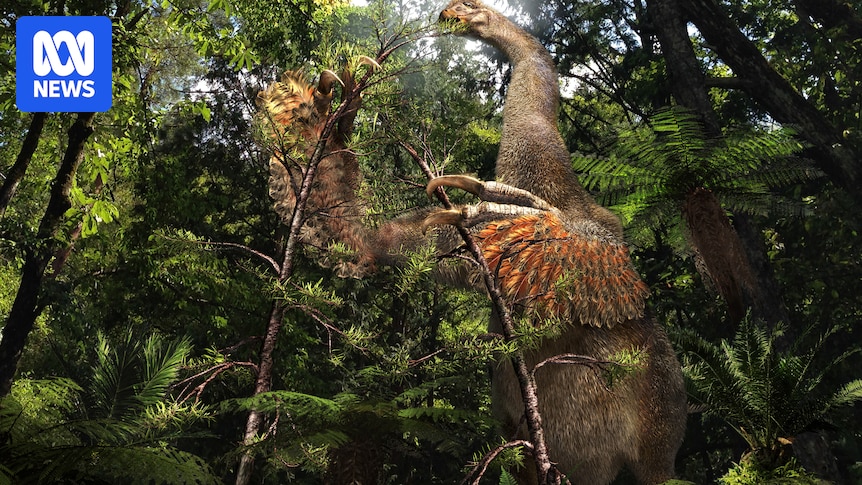
A reconstruction of the Cretaceous dinosaur Duonychus tsogtbaatari. With two-fingered hands and long «nasty» claws, the Duonychus tsogtbaatari is certainly a strange sight. Fossils of this dinosaur were recently unearthed in Mongolia’s Gobi Desert while a water pipeline was being constructed. Scientists say the Duonychus was a member of a group of «some of the weirdest dinosaurs ever». So just how remarkable is this discovery? Scientists say the Duonychus measured about 3 metres long and weighed roughly 260 kilograms. Its claws measured about 30 centimetres long. «These were big, sharp and nasty claws,» University of Calgary palaeontologist and study co-author Darla Zelenitsky said.
The introduction discusses the recent discovery of the unusual dinosaur Duonychus tsogtbaatari, with its two-fingered hands and long claws unearthed in Mongolia’s Gobi Desert during pipeline construction. Scientists describe the Duonychus as part of the group containing some of the weirdest dinosaurs and highlight its unique features such as size, weight, and remarkably long claws. The significance of this discovery is emphasized by palaeontologist Darla Zelenitsky, who notes the large, sharp claws of the dinosaur, suggesting its peculiarity and contribution to understanding the diversity of dinosaur features.
Discovery of Duonychus tsogtbaatari in Mongolia
The discovery of Duonychus tsogtbaatari adds to the growing list of peculiar theropods unearthed in the Gobi Desert. This region not only provides a multitude of fossils due to its high erosion and scant vegetation, but also offers insights into the evolutionary trajectories of these ancient creatures. The exceptional preservation of the Duonychus, especially in terms of its keratin-clad claws, sheds light on the multifaceted uses of its unique anatomical features. This find illustrates the diverse adaptations and evolutionary experimentation present during the Cretaceous period, as evidenced by the two-fingered hands of the Duonychus, which stand in stark contrast to the typical three-fingered therizinosaurs. The detailed preservation of the Duonychus’ limbs reveals much about its lifestyle, offering glimpses into how such dinosaurs interacted with their environments and used their specialized anatomy in feeding and possibly other behaviors.
Remarkable Preservation and Keratin Fossilisation
The Gobi Desert’s conditions that allow for such remarkable fossil preservation are quite fascinating. The harsh climate of the region contributes significantly to the erosion of rocks, which in turn unveils hidden fossils. According to Tim Ziegler, this lack of vegetation in the desert area makes it easier for paleontologists to spot exposed fossils as they are gradually revealed by erosion. These factors have contributed to a surge in new dinosaur discoveries. Scientists find themselves amidst a renaissance in the field of paleontology, with more dinosaurs being identified and studied than ever before. Mr. Ziegler notes that such preservation discoveries, like the keratin sheath found on the Duonychus claw, provide invaluable insights into the anatomy and lifestyle of these ancient creatures. As the exploration of this rich fossil bed continues, researchers remain optimistic about unearthing even more fossilized wonders in the future.
How Therizinosaur Claws Were Used Beyond Feeding
The discovery of Duonychus tsogtbaatari in the Gobi Desert offers significant insights into the evolution of therizinosaurs and their adaptations. This medium-sized dinosaur stands out due to its shortened two-fingered hands, a distinct deviation from its three-fingered relatives. Its peculiar anatomy underscores an evolutionary trend known as digit reduction, where over time, fewer fingers or toes develop as a species adapts to its environment. This reduction seemingly posed no disadvantage to Duonychus, whose construction of limbs and claws appears to have been well-suited to its lifestyle. Researchers believe the dinosaur primarily used its formidable claws for feeding by pulling down branches, though they could have served multiple functions, including defence and social signalling within its species. The Duonychus exemplifies a unique evolutionary experiment, demonstrating how dinosaur lineages explored various traits to thrive in their ecosystems.
The Role of Keratin Fossilization in Dinosaur Discoveries
In conclusion, the discovery of Duonychus tsogtbaatari offers invaluable insights into the fascinating and diverse world of dinosaurs. Its unique characteristics, such as the two-fingered hands and massive claws, highlight the evolutionary adaptations these creatures underwent. As the scientific community continues to delve into the mysteries uncovered in the Gobi Desert, remarkable findings like this contribute significantly to our understanding of dinosaur biology and evolution. This ongoing research underscores an exciting period in paleontology, where more discoveries await to add to the rich tapestry of our planet’s ancient history.